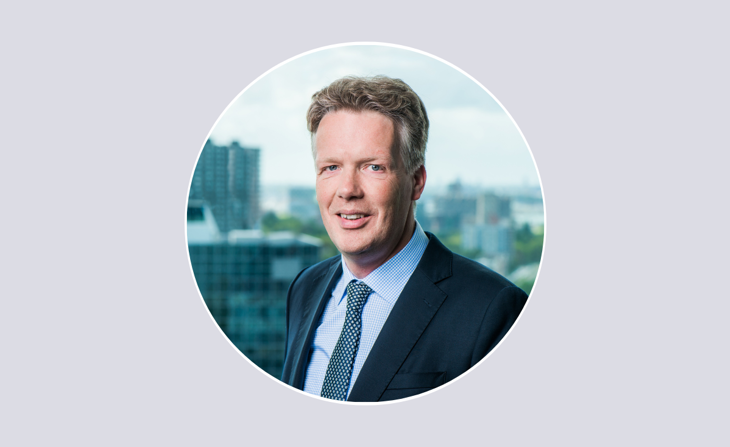
Ton van Welie: When I heard the news, my first reaction was of pride — not just for the award itself, but for what it represents.
For many years, Ortec Finance has been a trusted name in the global pension and wealth industry, and in the last five years, we’ve worked hard to expand into insurance. This award tells me that the market recognises that effort. It’s a milestone that says: “you’re not just participating; you’re helping to lead”.
"That means we don’t chase short-term profit; we invest about 40% of our revenues back into innovation."
What makes this recognition so special to me is that it validates our philosophy. We believe that better decisions come from better models — and building those models isn’t easy. It requires long-term commitment to our principles, our clients, and our people. That’s why our implementation track record is so strong: when we start a project, we deliver. Our client retention rate of over 96% speaks volumes about the trust we build.
I’m also proud of our ownership model. Ortec Finance is 100% employee-owned, with more than 30 shareholders and over 200 employees holding certificates. That means we don’t chase short-term profit; we invest about 40% of our revenues back into innovation. Because everyone has skin in the game, there’s a shared sense of responsibility and pride. For me, that’s the foundation of everything we do.
Ton: Innovation isn’t a buzzword for us — it’s who we are. Ortec Finance was founded by PhD students in the 80s, and that academic curiosity and drive still runs through the company. Many of us, me included, still teach at universities, and it’s a link that keeps us sharp and open-minded.
"For 48 hours, cross-functional teams work on any idea they believe adds value. Over 40% of those ideas made it into our solutions."
We’ve built rituals around innovation: Research Meetings, Tech Tuesdays, Labs, and once every Friday, an all-employee meeting where teams from Toronto, Melbourne, Singapore, Zurich, London, Amsterdam, and Rotterdam share ideas.
One of my favourite traditions is our “Hackathons”. For 48 hours, cross-functional teams work on any idea they believe adds value. Over 40% of those ideas made it into our solutions. That’s incredible when you think about it — and it shows what happens when you give people freedom to experiment.
We organise ourselves in small, agile teams with end-to-end responsibility. That autonomy fosters entrepreneurship. We encourage people to try new things, even if it means failing sometimes. And that mindset is what keeps us — as a specialist provider — ahead.
Ton: Our approach is structured but practical. It starts with modelling client-specific goals, then making risks and expected returns explicit through scenarios, and finally assessing strategy alternatives objectively and transparently. This isn’t just theory — it’s a way to turn complexity into clarity.
The biggest impact? Consistency and transparency. When clients can see the trade-offs clearly, they make better decisions.
And because we deliver our models through software, we ensure automation and efficiency without compromising quality. But here’s the part I love: we don’t just hand over tools. We guide clients, share our opinions, and help them get the best out of technology. That partnership is what makes the difference.
Ton: Looking backwards is useful, but it’s not enough. The world is changing fast — climate risks, macroeconomic shifts, geopolitical uncertainty. Our solutions help insurers look ahead by simulating a wide range of plausible futures. We integrate macro trends, climate scenarios, and market volatility into forward-looking models so clients can prepare, not just react.
"That’s where we see the real value — helping clients move from reactive risk management to proactive risk strategy."
This isn’t about predicting the future with certainty; it’s about resilience. By exploring what could happen, insurers can make strategic choices that stand up to uncertainty. That’s where we see the real value — helping clients move from reactive risk management to proactive risk strategy.
Ton: That’s a question I’m genuinely excited about, because we’re seeing a real transformation in how technology — especially AI and machine learning — is reshaping investment risk management.
Let me share a concrete example: Traditionally, optimising insurance portfolios has been a balancing act between realism and efficiency. On one hand, you have highly realistic scenario-based approaches, which are accurate but slow and computationally intensive, as you have to iteratively find the optimal strategy. On the other hand, you have closed-form optimisers like classic mean-variance models, which are fast but often too simplistic for the real-world complexity insurers face.
What’s ground-breaking now is the emergence of Scenario-Based Machine Learning (SBML). This approach combines the best of both: the flexibility and realism of stochastic scenario analysis, and the efficiency of machine learning. In practice, we generate a vast set of realistic economic scenarios based on the client's capital market assumptions and then use machine learning algorithms to train surrogate models on this data. These surrogate models act as a kind of “shortcut”, allowing us to quickly and efficiently search for optimal portfolio solutions across a wide range of risk and return measures — even when the objectives are complex, like maximising the present value of distributable earnings while minimising capital injections over a 10-year horizon.
What I find most exciting is that SBML isn’t just about speed. It enables us to optimise portfolios in three-dimensional spaces, taking into account three objectives — for example, solvency, liquidity, ESG, and more — all at once.
"AI — specifically scenario-based machine learning — is helping us move from theory to practice, making advanced risk management accessible for insurers."
Because the optimisation step is so efficient, we can explore a much broader set of possibilities, helping insurers make better, more robust decisions in a world full of uncertainty. Any combination of objective metrics that can be calculated by our ALM model can be optimised upon.
The human element remains essential. Machine learning can provide powerful tools, but ultimately, the strategist must own the process. We see our role as empowering analysts and decision-makers: giving them the ability to focus on storytelling, holistic advice, and robust scenario planning, rather than getting lost in computational details.
AI — and specifically scenario-based machine learning — is helping us move from theory to practice, making advanced risk management accessible, explainable, and actionable for insurers. That’s the kind of innovation that makes me proud to be part of Ortec Finance.